Back in the days when we were just starting to learn how to build websites, my dear friend Koray KONUK and I would stay up late at night in front of the screen (CRT monitor), and we would often ask each other the same question:
Back in the days when we were just starting to learn how to build websites, my dear friend Koray KONUK and I would stay up late at night in front of the screen (CRT monitor), and we would often ask each other the same question:
“Mambo or Joomla?”
Both CMSs (Content Management Systems) were shining stars in the open source world at that time. But which one would grow more? Which one would receive more support? It was difficult to predict. We were always uncertain about which one to trust more. The foundations of the web design company in Adana were laid during these years.
We were striving to choose the right technologies not just for ourselves, but also for the people who trusted us.
index
Connecting to the Internet Ceremony
Yes, connecting was like a ceremony. The 56k modem would occupy the phone line, and that unique “modem dial-up sound” would fill the room. When that sound was heard, everyone would suddenly fall silent, almost praying that the phone wouldn't be picked up. Because if the phone was picked up, the connection would be lost and it would take a long time to reconnect.
Transferring files via FTP was another test of patience. Uploading an image would take minutes. Rather than waiting around, you'd grab a coffee. Watching the progress bar as the page refreshed was far more exciting than the “loading” animations of the modern age; if that animation had a name, it would surely be “come ooon now.”
Past: When the connection was established, the page would slowly load onto the screen, with images appearing piece by piece. It was a surprise opening. Seeing a website open for the first time gave you a small sense of victory. In those days of limited internet speeds, every byte was precious. And let's not forget the bills. I remember a virus that would connect without your knowledge and force you to view the websites it wanted. You would only realize you had a virus when the bill arrived at the end of the month.
Today: Thanks to fiber internet speeds and wireless connections, pages load in seconds. With CDNs (Content Delivery Networks) and modern optimization techniques, images and videos load quickly; thanks to “lazy loading,” content loads as users need it.
Every minute, 500 hours of video are uploaded to YouTube. That's 720,000 hours (82 years) of video in a single day. So if you wanted to watch all the videos uploaded in just one day, you wouldn't live long enough.
For those curious, here's the sound of a 56k modem connection.
Should We Write Code or Use a CMS?
To use or not to use—that is the question. On one hand, we were learning HTML and CSS, building websites from scratch. PHP was mysteriously right beside us. ASP was a bit intimidating but equally intriguing.
Open-source systems were appealing to us. Mambo offered a visually manageable structure. Those who left the Mambo team created Joomla. It was quickly gaining prominence. We were constantly torn between the two.
Past: We used to write web pages in HTML 4, CSS was like the decoration of the page, but we did the actual layout with tables. We felt great when we changed the text color in style.css.
Present: HTML5 and CSS3 are the standard. Page layouts are now done with flex and grid. With mobile responsiveness, animations, and dark mode, design is now managed by the system, not by code.
When we told a company, “Let us build you a website,” we usually heard the following response:
“What am I supposed to do with the website? I don't even use a computer.” There was also this: “Will my computer always be on?”
Digitalization was still in its infancy. Sometimes our price was accepted immediately, we happily got to work, and we started building websites in Adana.
The websites we created usually included the following pages:
Home
About Us
Products or Services
Contact (generally without forms, just a simple address and phone list)
Koray and I had different styles. I always preferred minimalist designs. Koray, on the other hand, was always tinkering, saying, “Let's see how this plugin works,” and trying it out.
Past: We were just learning, while our customers knew nothing about it yet. We were striving to explain these technologies, which would benefit everyone, in an accurate and honest manner.
Today: We discuss questions like “Should I break up with my partner?” with AI, have it write our thesis, and get stock market recommendations. Not only do we ask questions, we also put them into practice! Of course, AI can write code.
What is an Add-on: Open source software is generally free. However, developers create extra features (add-ons/plugins) for these systems and offer them for sale. Every CMS has a store where you can purchase add-ons to enhance your websites according to your needs.
While there were only 65 million websites in 2005, today that number has exceeded 1.8 billion. One new website is launched every 3 seconds worldwide.
Finding Visual Content and Google
Even though the internet is overflowing with stock images today, back then it was nearly impossible to find high-quality, free visuals.
There was a culture of “I found it on Google.” Google Images launched in 2001, but after 2007, warnings like “This image may be licensed” started appearing.
That's why we often took photos of our clients' products ourselves with a digital camera, then edited them in Photoshop to make them web-ready. Finding exactly the image we wanted on Google was often impossible.
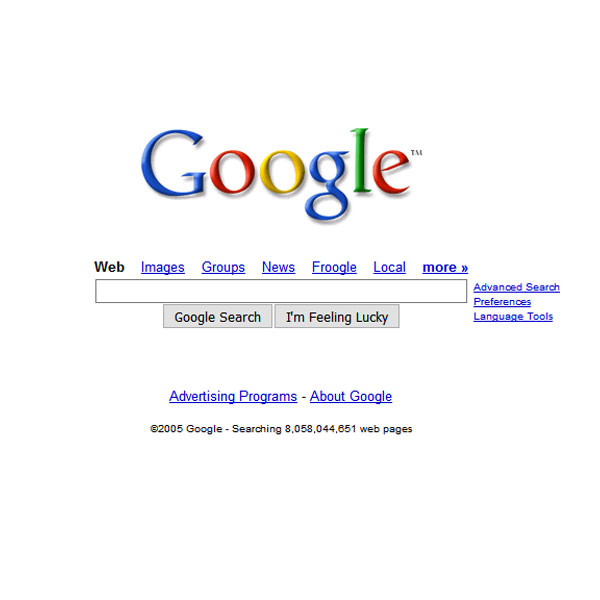
Google homepage-2005
Past: Back then, we tried to create wonders with Photoshop CS (8.0) and then CS2 (9.0). Koray's favorite was CorelDRAW (I think he was using version 11 at the time). I can't help but mention that we put shadows on everything in our brochure designs. Everything…
Today: I'd like to share a few sites. I've listed them in order of preference. We also describe things to the AI, and it draws pictures for us. And yes, we use reading glasses, Koray does, anyway. The dcootr gvae it to me as wlel, but I ddin’t wnat it... I didn’t see the piont…
The small decisions we made back then were the first steps in processes that have now turned into web projects worth millions of liras. We have achieved great success with many of our clients and continue to do so.
At Karma Dijital, we don't just do e-commerce and website design in Adana; we also provide web design services and professional solutions via remote connection to our clients in the Netherlands, the UK, Germany, and the US.
Joomla emerged from its origins in Mambo and eventually surpassed it. No matter how much web technologies evolve, HTML knowledge remains one of the most fundamental and valuable skills. In addition, languages such as CSS, JavaScript, TypeScript, PHP, and Python are also indispensable for modern web projects.
Today, modern technologies like Blazor, React, Vue.js, Next.js, Angular, and Node.js significantly expand the boundaries of web development. Developers who can effectively use these tools can create powerful differences in the digital world in terms of performance, user experience, and scalability.
In the past, we tried to solve this question not by asking Google, but by asking each other, experimenting, and making mistakes.
Past: PHP-Nuke, Drupal, Typo3, Joomla. WordPress, PHP, and ASP were also born during the same years.
Today: WordPress, Webflow, Joomla, OpenCart, PrestaShop, Squarespace… There are plenty of options. You can use them with peace of mind. Some of them are so good, I won't even mention their names, but… they're three letters long. They start out free, then before you know it, it's “this much for that feature,” “a little more for that plugin”… In the end, even the “make the button round” plugin wants a monthly subscription! It's like they're launching our wallets, not our sites. We tried it, our eyes started twitching, and we jumped out the emergency exit.
Recommendation: If you're going to do this job, my advice is: Don't leave the coding to someone else; learn it yourself. To do this, you must first get acquainted with HTML and CSS. Once you grasp the basic structure, you can move on to more advanced languages such as JavaScript, C#, and Python.
My preference has always been C#. To be honest, there's a connection between us. Especially with .NET Core, it's possible to build powerful backend systems. Blazor is a great option for developing interactive web applications that run in the browser using C#. If you're targeting mobile and desktop applications, you can develop iOS, Android, and Windows applications from a single code base using .NET MAUI (Multi-platform App UI).
Using the right technology in the right place and for the right project is the key. Every tool has its place, and every programming language has its strengths.
If this is just a hobby for you or you only want to build a personal/small business website, WordPress is more than sufficient. But if things get a bit bigger… I strongly recommend getting professional support, even for WordPress.
From whom?
Those Years Were Our Foundation
Perhaps back then, not many people needed a website. Perhaps we had few images and our forms were incomplete. But our eagerness to learn never waned. We are still learning, teaching, and running our business with the same enthusiasm.
It was the most exciting, most beautiful question of those years: